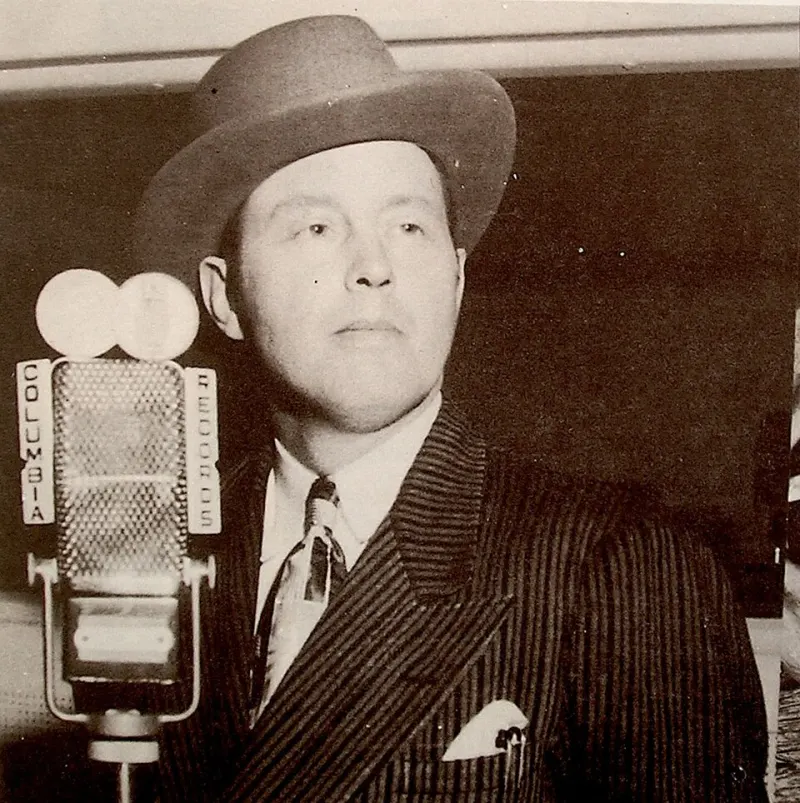
Most kinds of music have no single inventor. Bluegrass does. It is named after Bill Monroe's band, the Blue Grass Boys, and for once the story that one man created a musical style is more or less true.
The father of bluegrass
Monroe was born in 1911 on a farm near Rosine, in western Kentucky, the youngest of eight children. He learned the mandolin because his older brothers had already claimed the fiddle and the guitar, and he learned a great deal about rhythm and the blues from a Black fiddler and guitarist in the area, Arnold Shultz. His mother's brother, Pendleton Vandiver, was a fiddler too; Monroe later wrote a tune for him, "Uncle Pen".
In the mid-1930s Bill and his brother Charlie recorded as the Monroe Brothers, and their records were fast, hard-edged and full of Bill's high tenor harmony. The brothers split in 1938. The next year Bill formed the Blue Grass Boys, auditioned for the Grand Ole Opry with a blistering version of Jimmie Rodgers' "Mule Skinner Blues", and was hired on the spot.
The original bluegrass band
For several years the Blue Grass Boys were an excellent string band, but not yet what we now call bluegrass. The sound came together in 1945 and 1946, when Monroe hired two young players. Lester Flatt, a singer and guitarist, gave the band a warm lead voice. And Earl Scruggs, a 21-year-old banjo player from North Carolina, played with a three-finger picking style that turned the banjo from a rhythm instrument into a lead one, rolling out a stream of notes faster than anyone had heard.
With Chubby Wise on fiddle and Cedric Rainwater on bass, that band — mandolin, banjo, fiddle, guitar and bass, everyone taking solos like a jazz group, all of it acoustic — set the template for bluegrass. Musicians still call it the original bluegrass band. Their records together, like "Blue Moon of Kentucky" and "Molly and Tenbrooks", are where the style begins.
High lonesome
What makes bluegrass sound like bluegrass? The drive, first: the mandolin chopping on the off-beat, the bass on the downbeat, and the banjo rolling over both, fast and relentless. The singing, second: a high, strained lead or tenor that critics came to call the high lonesome sound, with close harmony above it. And the songs, which reach back to the ballads and hymns of the Appalachians — murders, mothers, trains, and heaven.
Monroe was a demanding, sometimes forbidding bandleader, and Flatt and Scruggs left in 1948 to form their own group, the Foggy Mountain Boys. Monroe did not speak to them for years. But their departure spread the sound. The Stanley Brothers, from the mountains of south-west Virginia, played it in a harder, more mournful style. Reno and Smiley, Jim and Jesse, and the Osborne Brothers followed.
The folk revival
In the 1950s bluegrass had a problem: country radio, chasing the rock-and-roll audience, was moving away from acoustic music altogether. Rescue came from an unlikely direction — college students in the folk revival, who discovered bluegrass as a living form of old American music.
Flatt and Scruggs played the Newport Folk Festival, and their theme for the 1962 television show The Beverly Hillbillies, "The Ballad of Jed Clampett", went to number one on the country chart. Five years later "Foggy Mountain Breakdown", which they had recorded in 1949, was used in the film Bonnie and Clyde, and a generation of guitar students set out to learn the banjo. In 1965 the first multi-day bluegrass festival was held at Fincastle, Virginia; Monroe started his own at Bean Blossom, Indiana, in 1967, and summer festivals became the music's real home.
After the founders
Bluegrass kept changing, over the objections of its purists. In the 1970s "newgrass" bands like New Grass Revival brought in rock and jazz. Tony Rice redefined bluegrass guitar. Alison Krauss, a fiddle prodigy from Illinois, became one of the most awarded musicians in Grammy history.
In 2000 the soundtrack to the Coen brothers' film O Brother, Where Art Thou?, full of old-time and bluegrass songs, sold millions of copies with almost no help from country radio, and won the Grammy for Album of the Year. Its best-known song, "I Am a Man of Constant Sorrow", was sung by Dan Tyminski of Krauss's band, Union Station.
Bill Monroe died in 1996, four days short of his 85th birthday. Today a new generation — Billy Strings, Molly Tuttle, Sierra Hull — plays to crowds the founders could not have imagined.
Where to hear it
Bluegrass has rarely been heard on commercial country radio for sixty years. It survived on public radio, on festival stages and, now, online. Bluegrass Country in Washington plays it all day, and our bluegrass stations page lists the rest. If you are new to the music, start with our beginner's guide to bluegrass.