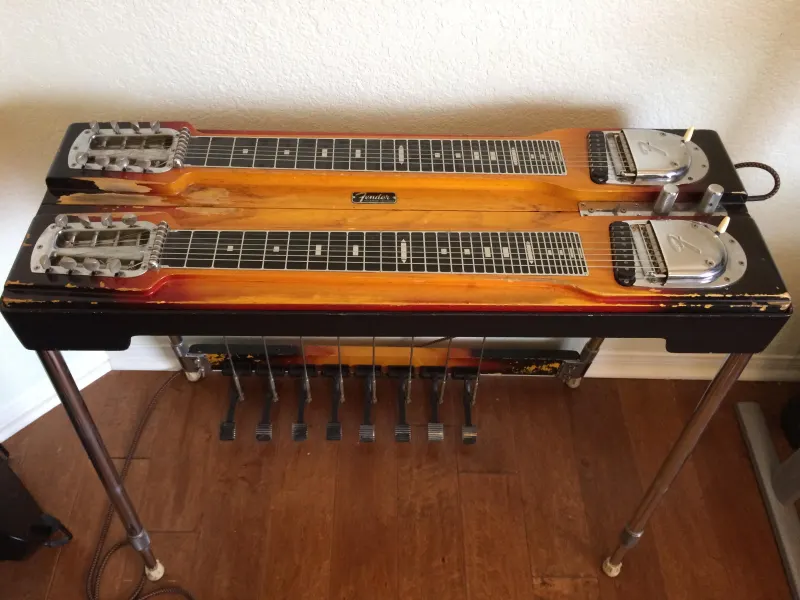
Close your eyes during almost any country song and you can name the genre in a second, often from a single instrument. A few of them are so tied to the music that they sound like country all by themselves. Here is a guide to the sounds, and to the records where you can hear them best.
The fiddle
The fiddle is the oldest voice in country music. The first country record, in 1922, was a fiddle record, and the first barn dances on the radio were fiddle contests. It came to America with settlers from Scotland, Ireland and England, and absorbed African American styles along the way.
In a modern band it plays the long, weeping notes behind a ballad, answers the singer between lines, and cuts loose in the solos. Listen for "twin fiddles" — two fiddles playing in harmony — on honky-tonk and western swing records, and on almost everything George Strait has made.
The banjo
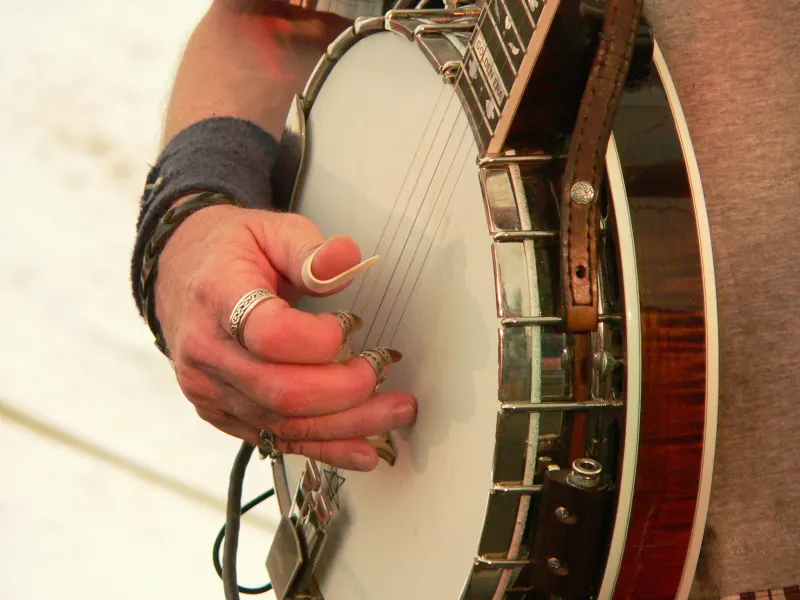
The five-string banjo has a history older than country music itself. Its ancestors were gourd instruments that enslaved Africans made and played in the Caribbean and the American South, and in the nineteenth century it was the lead instrument of minstrel shows before it became a staple of mountain string bands.
Older players struck the strings downwards with the back of a fingernail, a style called clawhammer or frailing. In the 1940s Earl Scruggs, playing with Bill Monroe, popularised a three-finger picking style that made the banjo a lead instrument, fast and rolling. It is the sound of bluegrass. Start with Flatt & Scruggs' "Foggy Mountain Breakdown".

The steel guitar
No sound says country like the steel guitar. It started in Hawaii, where players laid the guitar flat across their laps and slid a steel bar along the strings, and Hawaiian music was a craze across America in the 1910s and 1920s. Country musicians picked it up, then electrified it: the lap steel was a staple of western swing bands in the 1930s.
The pedal steel came next. By adding pedals and knee levers that change the pitch of individual strings while they ring, players could bend notes inside chords, creating that crying, swooping sound. Bud Isaacs' playing on Webb Pierce's 1954 hit "Slowly" is usually credited as the first hit record to use pedal bends, and within a couple of years every studio in Nashville wanted it. Listen to almost any classic honky-tonk ballad to hear what it does to a sad song.
The dobro
The resonator guitar, often called by the brand name Dobro, has a metal cone inside the body that acts like a loudspeaker. It was invented in the 1920s by the Dopyera brothers, Slovak immigrants in California, to make guitars loud enough to be heard in a band — and "Dobro" is both a contraction of their name and the Slovak word for "good". Played with a slide, like a steel, it has a bright, singing tone. It is a bluegrass staple; Jerry Douglas is its modern master.
The mandolin
Bill Monroe played a Gibson F-5, a model designed in the early 1920s, and turned the mandolin into one of the defining sounds of bluegrass: the sharp chop on the off-beat that keeps time, and fast, bluesy solos. It is small and high-pitched, and in a bluegrass band it does the work drums would do.
The acoustic guitar
The flat-top acoustic guitar is country's backbone. Maybelle Carter's "Carter scratch" — melody on the bass strings, rhythm brushed on the treble — shaped how country guitarists played for generations. Doc Watson later made flatpicked fiddle tunes on the guitar a style of its own, and Tony Rice took it further. The big, deep-bodied "dreadnought" guitar, made famous by Martin, is the classic country acoustic.
The Telecaster
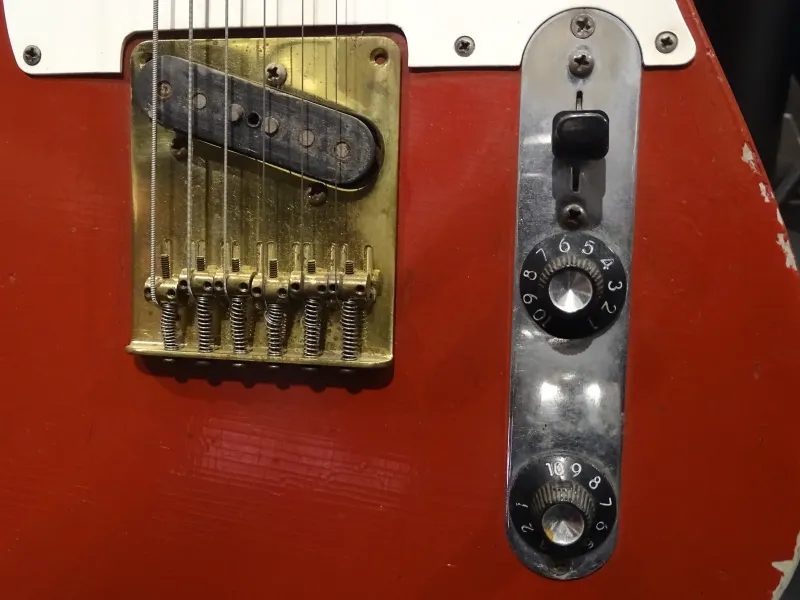
In 1950 Leo Fender, in Fullerton, California, put out a plain, solid-bodied electric guitar that would become the Telecaster. Its bright, cutting tone — the twang — made it the guitar of country music, above all in Bakersfield, where Buck Owens and Don Rich built a whole sound on it. Listen to "Act Naturally" or "I've Got a Tiger by the Tail".
_-_Rock_%26_Roll_Hall_of_Fame_and_Museum,_Cleveland_(by_Adam_Jones).jpg)
In the late 1960s two members of the Byrds, Clarence White and Gene Parsons, invented the B-Bender, a lever that lets a guitarist bend one string up while playing, imitating a pedal steel. Modern pickers from Brad Paisley to Vince Gill have made the Telecaster sound dazzling.
The piano
Country piano ranges from the barrelhouse boogie of honky-tonk to Floyd Cramer's "slip-note" style on the Nashville Sound records of the early 1960s — a way of sliding into notes that imitates a steel guitar's bend. Listen to his instrumental "Last Date" to hear it.
The drums
For years the Grand Ole Opry frowned on drums, and early country records rarely used them. Western swing bands brought them in, honky-tonk made them standard, and by the 1960s they were on almost every record. Today most country records have a full rock rhythm section. Bluegrass, notably, still does without.
Hear them
Every one of these instruments is on the air right now. For the fiddle and steel, try a honky-tonk station; for the banjo, mandolin and dobro, a bluegrass station; for the Telecaster, anything playing Buck Owens or Dwight Yoakam. On air now shows what every station is playing, so you can pick one mid-song.