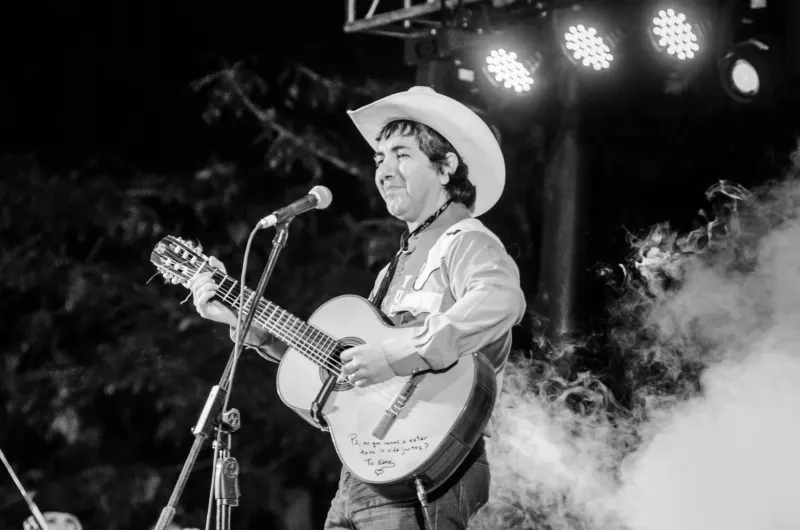
Country radio entered the 2010s as powerful as it had ever been. It was still one of the most-listened-to formats in America, and it could still make a star. By the middle of the 2020s it was one route to an audience among several — and country music was bigger than ever.
Bro-country
The sound of the early 2010s was built for a party in a field. Florida Georgia Line's "Cruise", in 2012, was about a girl, a truck and a back road, with a beat borrowed from hip-hop and a chorus built for singing along; a remix with the rapper Nelly the next year made it one of the best-selling country singles ever. Luke Bryan, Jason Aldean and Blake Shelton had records in the same vein. In 2013 the critic Jody Rosen gave the style a name that stuck: bro-country.
It was hugely popular, and it had plenty of critics, including inside Nashville. In 2014 the duo Maddie & Tae had a hit with "Girl in a Country Song", which pointed out, with a smile, how little the women in these songs got to do besides wear cut-off jeans and ride in the truck.
The charts change the rules
In October 2012 Billboard changed how it compiled its main country singles chart, Hot Country Songs. For decades it had been built on radio airplay; now it would add sales and, increasingly, streams, with a separate chart, Country Airplay, for radio alone. The two charts often disagreed, and the gap between them became a measure of how far the radio and the listeners had drifted apart.
The question of what counts as country came to a head in March 2019. A song called "Old Town Road", by a young rapper from Atlanta called Lil Nas X, had gone viral with banjo, trap beats and cowboy imagery, and entered the Hot Country Songs chart. Billboard removed it, saying it did not have enough elements of country music. A remix with Billy Ray Cyrus followed, and the song spent a record-breaking nineteen weeks at number one on the all-genre Hot 100. The argument about who got to decide what country was had only begun.
Who gets played
In 2015 a radio consultant told an industry publication that stations should not play female artists back to back, and likened women to the tomatoes in a salad, with the men as the lettuce. "Tomatogate" became shorthand for a real pattern: research by academics and journalists through the 2010s showed songs by women making up only a small minority of what country radio played, and Black artists fewer still.
The artists found other ways through. Kacey Musgraves' Golden Hour won the Grammy for Album of the Year in 2019 with very little country airplay. Mickey Guyton became the first Black woman nominated as a solo artist in a Grammy country category. And in 2024 Beyoncé released "Texas Hold 'Em", which made her the first Black woman to top the Hot Country Songs chart; when an Oklahoma station initially turned down a listener's request to play it, the backlash went round the internet within hours. Her album Cowboy Carter won Album of the Year at the Grammys in 2025, as well as Best Country Album.
Streaming and the new giants
Meanwhile, streaming changed who found an audience and how. Zach Bryan, a Navy veteran who had posted songs he recorded on his phone to YouTube, became one of the biggest stars in American music with barely any help from radio. Morgan Wallen broke streaming and chart records with long albums full of songs. Luke Combs, with a voice and catalogue that sounded like the '90s, became one of the most reliable hit-makers of the decade. Shaboozey's "A Bar Song (Tipsy)", in 2024, spent nineteen weeks at number one on the Hot 100, tying the all-time record.
Country also became a global music. Streams of country grew fast outside America, from the UK and Ireland to Australia, Canada and Germany, and big festivals like C2C in London sold out arenas. The directory on this site, with stations broadcasting from more than fifty countries, is one small measure of how far the music now travels.
And the radio?
Country radio is still one of the most listened-to formats in the United States, and still has something no streaming playlist does: a local voice, a sense of place, and a human being choosing what comes next. The best stations know it. What has changed is that the radio no longer decides alone.
That is part of why this site exists. Every station in our directory is a real broadcast, chosen and run by real people, from a Nashville institution like WSM to a one-person internet station playing western swing. We simply show you what each of them is playing before you tune in — and, on our chart, what all of them together are playing this week.
Hear it now
Our new country and country pop stations play today's hits, and On air now shows every song playing across the directory this minute.